Trip reportSul de Minas · Alta Mogiana · Cerrado Mineiro, Brazil·Jul 20 – Jul 26, 2026·Samples sent
Sibaristica Coffee Roasters
Saint Petersburg, Russia
You buy at two levels at once: containers of commercial-grade arabica at volume, and a thin specialty layer on top. Today that volume is contracted through Europe and Africa. This is what Brazil at origin looks like against it.
Days at origin
7
Regions covered
3
Partners visited
6
Containers / year in play
35–39
01
Trip summary
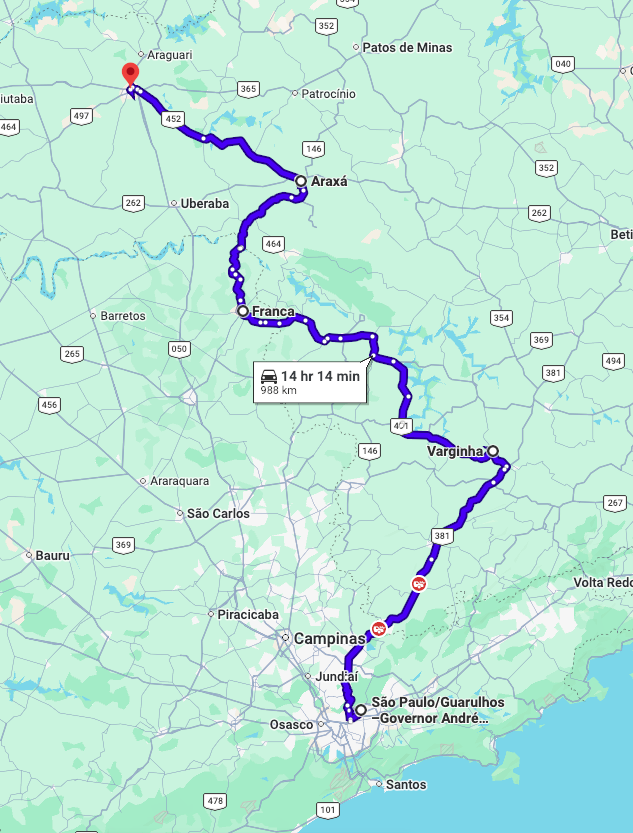
Seven days in Brazil, moving down three coffee regions in sequence: Sul de Minas for the trading and warehouse side, then Alta Mogiana and Cerrado Mineiro at farm level.
Brazil, quickly
What is structurally different about buying here, in four points.
01
Scale means a screen is a spec, not a hope
Brazil is the largest arabica producer in the world, and Sul de Minas alone accounts for close to a third of national production. At that scale, preparation is industrialised: warehouses sort by size, density and colour as a routine operation. A screen 14/16 or 17/18 requirement is something a plant executes container after container rather than something a single harvest happens to deliver.
02
Price is decomposed, not quoted flat
Brazilian arabica is priced as the NY (KC) market plus a differential in cents per pound. The differential is what gets negotiated on quality, preparation, screen and timing, while the market leg moves on its own. This is different from a flat FOB quote and it is why every price in this report shows both parts.
03
Two harvests in one country
The commercial-grade volume and the specialty layer come from the same country but not the same logic. Volume is assembled in the warehouse and trading belt around Varginha; specialty comes farm by farm, with a name attached. Both were on this route, deliberately, and in that order.
04
The dry season is the harvest
July sits in the middle of the Brazilian harvest and in the dry season, which is why the trip was scheduled then, and why quality questions from the June rains were still being assessed while we were there.
Itinerary
Jul 20 – Jul 26, 2026
Mon Jul 20
São Paulo
Arrival at Guarulhos (GRU) at 22:30. Transfer and overnight before the road.
Tue Jul 21
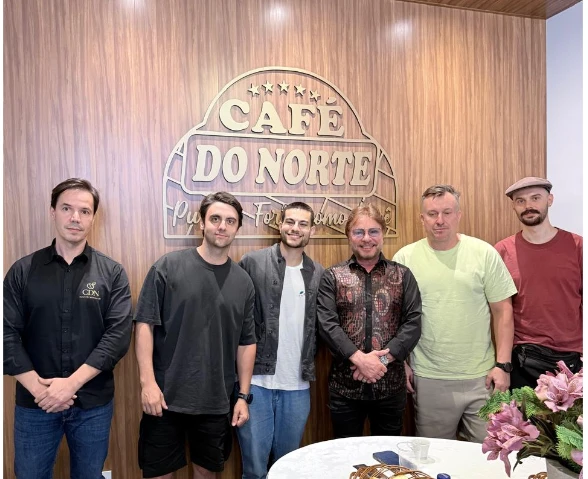
VarginhaCDN Trading: Cícero, Alexandre · LIV Logística
07:00 departure from São Paulo, ≈ 310 km via Fernão Dias, arrival ≈ 11,30. CDN first, to see how a Brazilian exporter prices against the NY board and builds a differential. Then LIV in the afternoon, the plant that executes it: rebenefício, storage and dispatch.
Wed Jul 22
VarginhaMinasul: Caroline Nery, Rasta
Full day in Brazil's largest arabica hub. Minasul warehouse, classification lab and dispatch: the volume side of the conversation.
Thu Jul 23
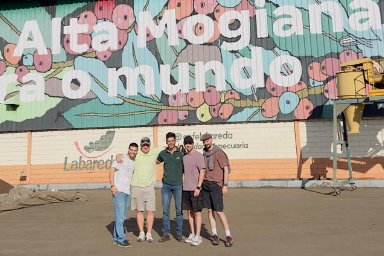
FrancaLabareda: Rafael, Douglas
06:30 departure, ≈ 310 km, arrival ≈ 11,30. Afternoon at Fazenda Labareda: first move from warehouse to farm level, Alta Mogiana specialty.
Fri Jul 24
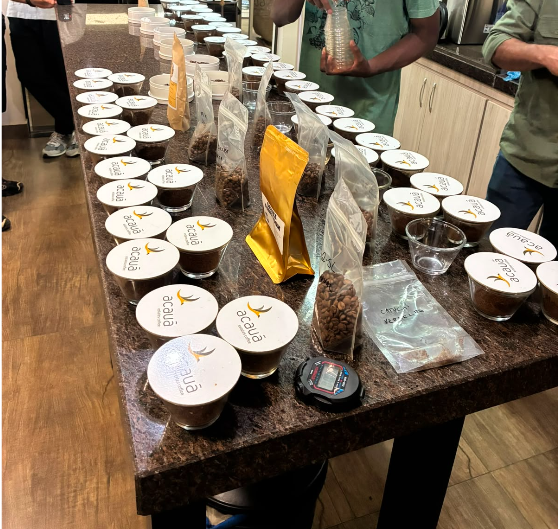
AraxáAcauã: Josué · Rodomunho, Thiago Corsi and family
08:30 departure, ≈ 170 km, arrival ≈ 11,00. Acauã warehouse in Araxá: preparation, sorting and blending to spec. Then Fazenda Rodomunho: regenerative farming, on-farm processing, cupping at origin.
Sat Jul 25
Uberlândia
08:30 departure, ≈ 176 km, arrival ≈ 11:00. Afternoon open for farms in the Uberlândia region; evening LATAM flight UDI → GRU (19:25 / 20:55).
Sun Jul 26
São Paulo
International departure from GRU at 00:30.
02
Where we went
Three regions, six partners, in a deliberate order: the region where coffee is priced and shipped, then the two where it is grown. Each one answers a different question.
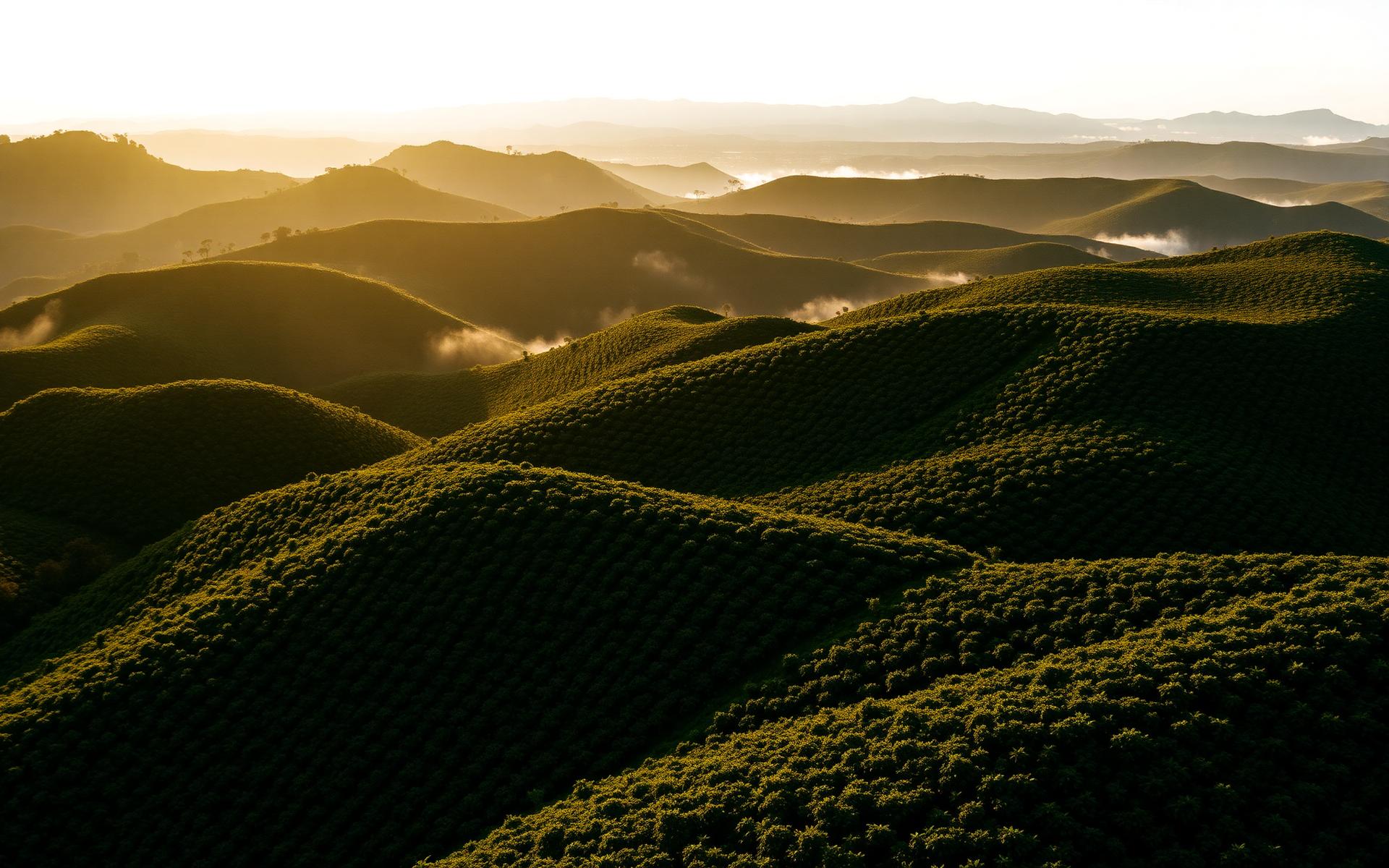
Sul de Minas, MG: the hills between Varginha and the producing belt.
01
Sul de Minas
Base · Varginha, MG
Where coffee is priced, stored and shipped
Sul de Minas is the largest arabica-producing area in Brazil and in the world, accounting for close to a third of national production. But the reason the trip started here is Varginha rather than the fields: it is the single largest coffee-exporting municipality in the country, commercialising roughly 25 million bags a year against about 10 million bags of storage capacity. Louis Dreyfus, Volcafé, Mercon, Sucafina, Cofco, Olam and Stockler all operate from the same few streets. If you want to understand how a Brazilian differential is built and how a container is actually assembled and shipped, this is the room where it happens.
CDN TradingLIV LogísticaMinasul
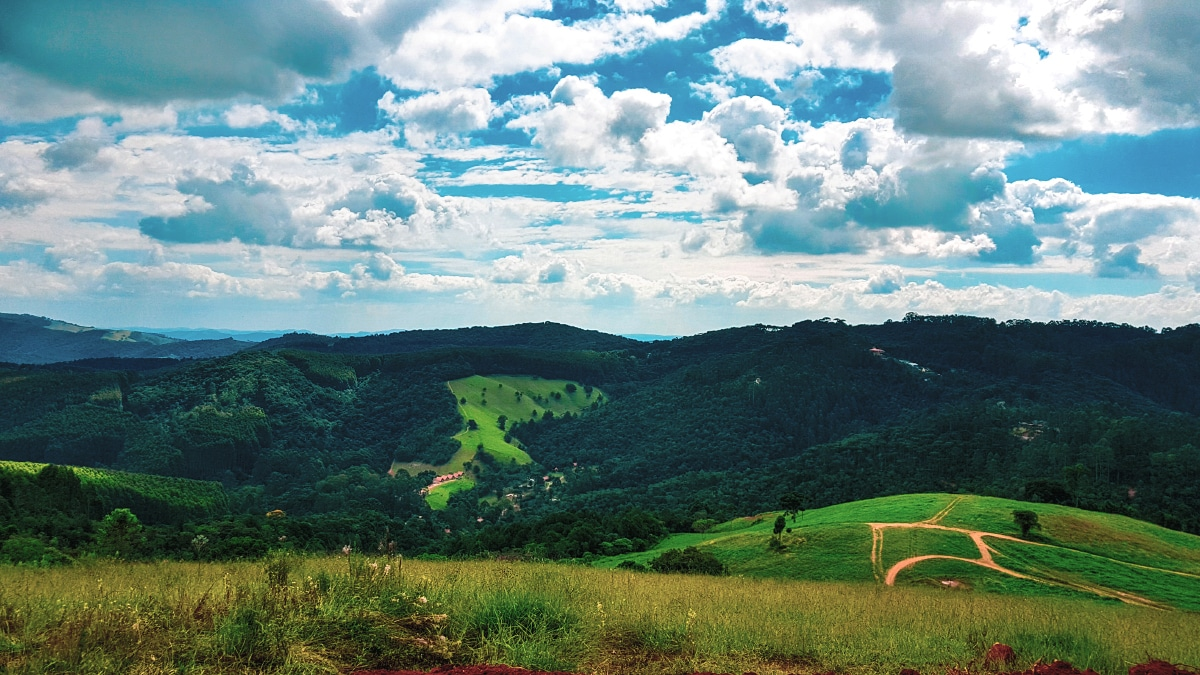
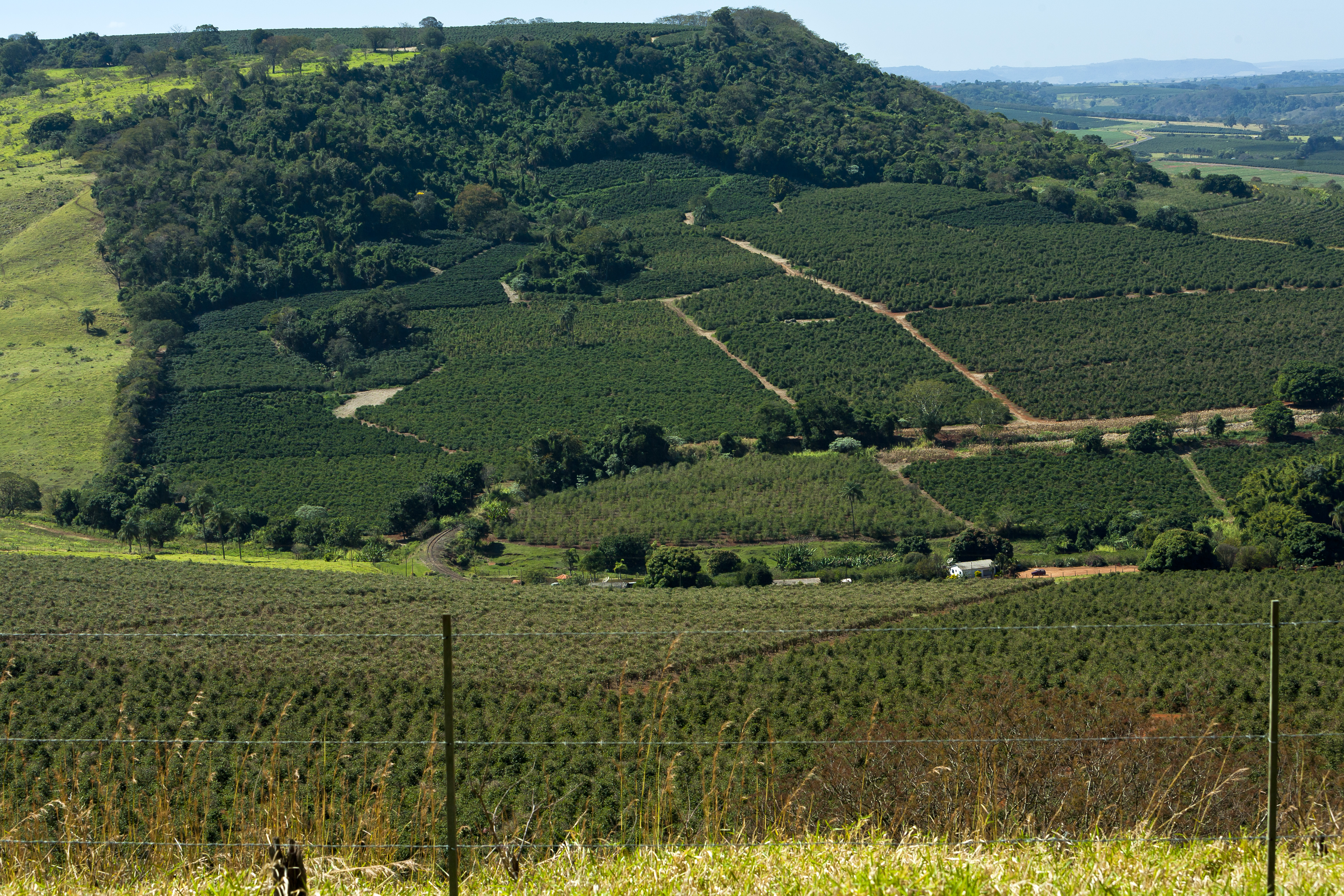
Alta Mogiana coffee plantation near Altinópolis, SP. Photo: Jonathan Wilkins, Wikimedia Commons, CC BY-SA 3.0.
02
Alta Mogiana
Base · Franca, SP
Where the coffee gets a producer's name on it
Northeast of São Paulo state, on the border with Minas. The plantings sit on hilly ground generally above 800 m, and the altitude combined with a mild climate, averaging 21 °C in summer and 17 °C in winter, slows ripening, which is what builds the sugars and aromatic compounds. The chain here organised itself: producers founded Alta Mogiana Specialty Coffee (AMSC) to guide quality and good practice on the farm and to protect the identity of the region's specialty coffees. This is the first stop on the route where you are dealing with a farm rather than a counterparty.
Fazenda Labareda
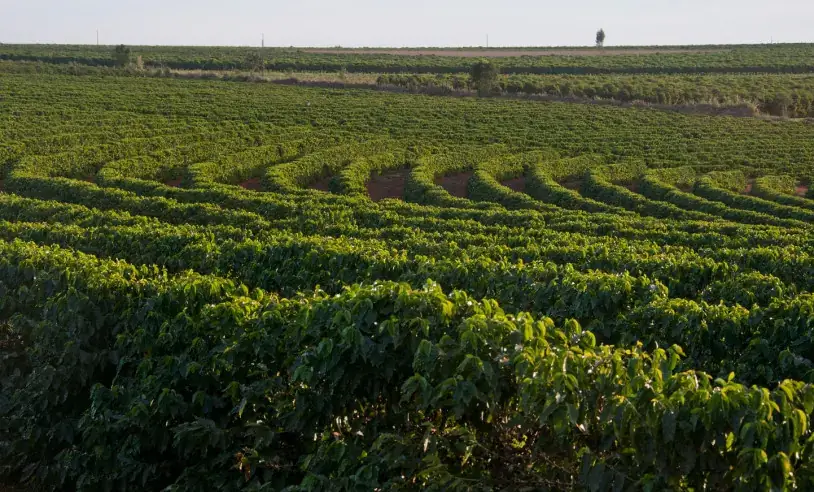
Cerrado Mineiro, MG: the plateau's uniform coffee rows.
03
Cerrado Mineiro
Base · Araxá, MG
Where consistency is the product
Northwest Minas Gerais: 55 municipalities, around 4,500 rural properties and 3,500 producers across roughly 155,000 hectares planted to coffee. It was the first Brazilian coffee region recognised as an Indicação de Procedência, in 2005, and since 2013 it is the first and only Brazilian coffee region to hold a Denominação de Origem: a legal statement that its arabica has sensory characteristics that cannot be reproduced anywhere else. What makes that stick is the climate: two sharply defined seasons, hot wet summer and mild dry winter, 18–23 °C, about 1,600 mm of rain a year, and no frost occurrence. Uniform ripening is not luck here, it is structural.
Acauã Armazéns GeraisFazenda Rodomunho
The route
988 km · 14 h 14 min road time. Source: Google Maps.
Day
Leg
Distance
Time
Depart
Jul 21
São Paulo → Varginha
≈ 310 km
4h00
07:00
Jul 23
Varginha → Franca
≈ 310 km
4h30
06:30
Jul 23
Franca → Cristais Paulistavisit spur
≈ 30 km
0h30
n/a
Jul 24
Franca → Araxá
≈ 170 km
2h30
08:30
Jul 24
Araxá → Rio Paranaíbavisit spur
n/a
n/a
n/a
Jul 25
Araxá → Uberlândia
≈ 176 km
2h30
08:30
Jul 25
Uberlândia → São PauloFlight
n/a
1h30
19:25
Road transfers by private car with a dedicated driver, departing early on every travel day so the afternoon stayed open for visits. The final leg is the LATAM flight UDI → GRU.
Pins mark municipality centroids. Labareda and Rodomunho both sit in zona rural, so their pins show the town they belong to rather than the farm gate.
The partners
01Trading & exportSul de Minas · Varginha, MG
CDN Trading
A trading desk with a roasting industry behind it, and the combination is what makes the structure work. Any trading house that buys a lot has to place every screen inside it. The good screens sell themselves; the low ones are the problem: the residue that has to be discounted, brokered onward or sat on, and that drag ends up priced into everything the desk quotes. CDN does not carry it, because Café do Norte, the industry behind the desk, absorbs the low screens internally. Nothing has to be dumped, so nothing has to be discounted to clear it. The margin on the whole lot holds, which leaves room to price the screens you are actually buying more sharply than a pure trading can, and it keeps the conversation simple, because there are no leftovers to negotiate around.
Trading desk with its own roasting industry behind it
Low screens absorbed internally instead of discounted to clear
Margin holds on the whole lot → room to price your screens more sharply
Varginha: Brazil's largest coffee-exporting municipality, ≈ 25 M bags/yr
Av. Salum Assad Davi, 81, Santa Luiza, Varginha, MG
02WarehouseSul de Minas · Varginha, MG
LIV Logística Armazéns Gerais
Same day as CDN, in the afternoon: the desk in the morning, then the plant that executes what the desk sells. LIV runs the entire green coffee flow in one place: intake in bulk, bagged or big-bag, rebenefício, storage, blending, quality control and dispatch. The scale is the point: 640,000 bags across 27 interconnected warehouses, running three shifts, morning, afternoon and night. Rebenefício is the specific capability worth noting: cleaning, destoning and sorting by size, density and colour is exactly the operation that turns a mixed intake into a defined screen. Every stored lot sits in an RFID-tagged big-bag with real-time tracking, and they hold 4C, UTZ, Rainforest, B3 and Smuckers (FSMA) certification. Dispatch goes out as sacaria, bulk liner, alpha-bag, bulk or big-bag.
640,000 bags across 27 interconnected warehouses · three shifts
Rebenefício: cleaning, destoning, sorting by size, density and colour
RFID-tagged big-bags, real-time tracking on every stored lot
4C, UTZ, Rainforest, B3, Smuckers (FSMA)
Dispatch as sacaria, bulk liner, alpha-bag, bulk or big-bag
R. do Comércio de Café, 185, Industrial Reinaldo Foresti, Varginha, MGlivlogistica.com.br
03Cooperative & warehouseSul de Minas · Varginha, MG
Minasul
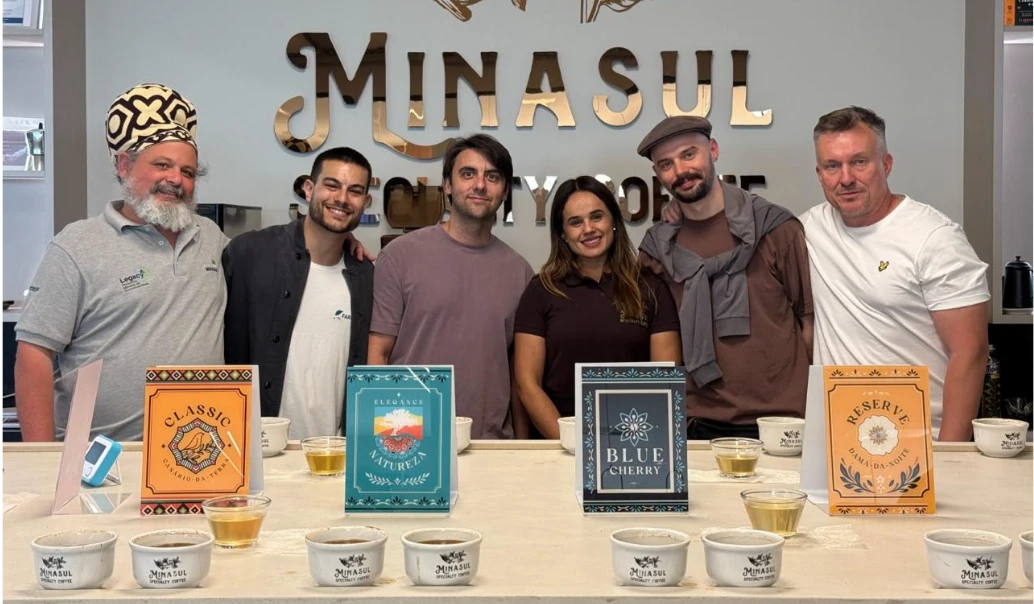
The counterweight to CDN. Where the trading desk shows how coffee is priced, Minasul shows where the coffee itself comes from, and it comes from 9,000 member families farming across more than 250 municipalities. That is the structural difference: a cooperative does not buy coffee on the market, it receives it from its own members, which means supply is a membership base rather than a position that has to be bought in. Founded in 1958 by a group of Varginha growers, it is today the second largest coffee-exporting cooperative in Brazil and commercialises over 2 million bags a year. The headquarters is a 143,000 m² complex where the whole chain sits in one building, and the visit ran it in order: coffee warehouse, then the classification laboratory, then the administrative floor. Intake, handling, processing, storage and dispatch are automated end to end with stock control throughout: the reason a cooperative this size can hold a spec across a season rather than lot by lot. The laboratory is the part that matters commercially: classification in-house is what lets them commit to a screen and a cup grade before the coffee moves.
Founded 1958 · 2nd largest coffee-exporting cooperative in Brazil
9,000 member families across 250+ municipalities: supply from membership, not from the market
2 M+ bags commercialised per year · 143,000 m² complex
In-house classification laboratory: screen and cup grade committed before shipment
Intake, handling, processing, storage and dispatch automated end to end
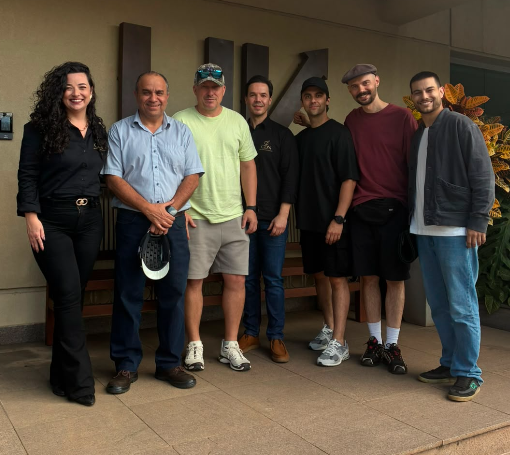
The first stop at farm level, and the moment the trip stopped being about volume and started being about a name on the bag. Labareda has been producing arabica in Alta Mogiana for over 40 years, at around 1,000 m; the Labareda Group was formed in 1984 and coffee remains the main crop. It is a family operation into its third working generation: Gabriel and Flavia are themselves grandchildren of coffee growers, and their sons work the farm full time. The plantings are Mundo Novo and Yellow Catuaí, and the farm holds Rainforest Alliance and UTZ certification and is recognised by the Alta Mogiana Specialty Coffee Association. Their natural took 3rd place in the region's own quality competition. Alongside the coffee sit more than 140 hectares of natural reserve; the operation runs about 100 people, rising to 180 at harvest.
40+ years in Alta Mogiana · ≈ 1,000 m · family into its third generation
Mundo Novo and Yellow Catuaí
Rainforest Alliance, UTZ, AMSC member
3rd place, natural category, Alta Mogiana quality competition
140+ ha of natural reserve · ~100 staff, 180 at harvest
The Cerrado's answer to the Varginha warehouse question, and the most technical stop of the week. Acauã holds 4,500 m² of storage for up to 100,000 bags on the edge of the BR-262, storing lots in a Big-Bags system with lot traceability and independent handling so nothing mixes or cross-contaminates. What matters commercially is everything it does besides store: intake in sacks, big-bags or bulk, cleaning and destoning, sifting to a uniform screen, density separation, electronic colour sorting for defects, and blending to a client's spec, then dispatch in several formats including GrainPro. That is precisely the toolset that turns a screen 14/16 or 17/18 requirement into something repeatable container after container. The warehouse belongs to Grupo Olini Rocha, which also farms São Matheus, Galícia, Malhada, Macaúbas and N. S. Aparecida: production and preparation under one roof.
4,500 m² · up to 100,000 bags · Big-Bags system, lot traceability
Cleaning, destoning, sifting, density separation, electronic colour sorting
Blending to client spec · dispatch incl. GrainPro
Grupo Olini Rocha: five farms behind the warehouse
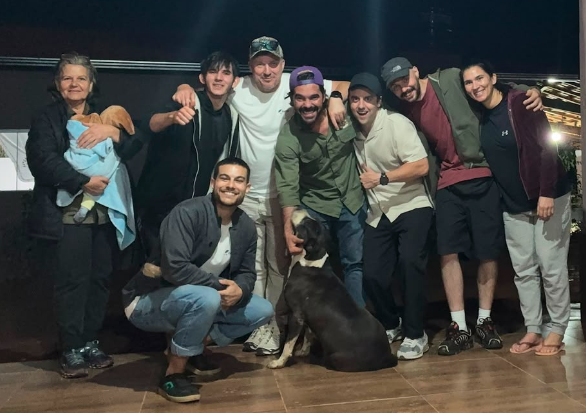
The farm that closed the week, and the clearest specialty story on the route. The family came to Cerrado Mineiro in 1985, after frost drove them out of Paraná, and settled on a highland plateau ringed by rock walls and fed by springs: natural barriers and a microclimate that slow ripening and give the cup its definition. In 2019 Thiago Corsi turned the farm toward specialty and toward regenerative agriculture, which here means treating soil and surrounding ecosystem as something to rebuild rather than merely protect, explicitly as a climate-resilience bet. They grow more than 20 arabica varieties, Yellow Bourbon the most expressive among them, with traceability held from planting through to the finished lot. The coffee reaches more than 20 Brazilian states and over 50 countries. This was the on-farm processing and cupping-at-origin stop.
Family in Cerrado Mineiro since 1985 · specialty turn in 2019
Regenerative agriculture as a climate-resilience programme
20+ arabica varieties · Yellow Bourbon the most expressive
Traceability from planting to finished lot
Exports to 50+ countries, present in 20+ Brazilian states
The requirement as recorded, line by line: the volume that needs placing each year.
Containers / year
35–39
Tonnes / year
700–780t
Confirmed lines
4
Everything below is confirmed required demand: the volume that needs placing each year, not an aspiration. It is also a floor rather than a ceiling: there is capacity to take more on every line against the right offer, so this is a starting position rather than the full size of the opportunity.
Basis · All containers 20 t. Screen 14/16 is the reference given, and it matches every arabica contract on the current book.
Fine cup
Arabica, fine cup
Containers / yr
12–14
Tonnes / yr
240–280
Bags / yr
4000–4667
Good cup
Arabica, good cup
Containers / yr
20
Tonnes / yr
400
Bags / yr
6667
Specialty
Arabica, specialty
Containers / yr
2–3
Tonnes / yr
40–60
Bags / yr
667–1000
Conilon
Robusta / conilon
Containers / yr
1–2
Tonnes / yr
20–40
Bags / yr
333–667
04
Coffees on the table
Samples collected
Transcribed from the bag labels. Where a field was left blank on the label, it is blank here too. Every price shown is the green coffee alone, FOB. Logistics and export costs are not in these numbers yet.
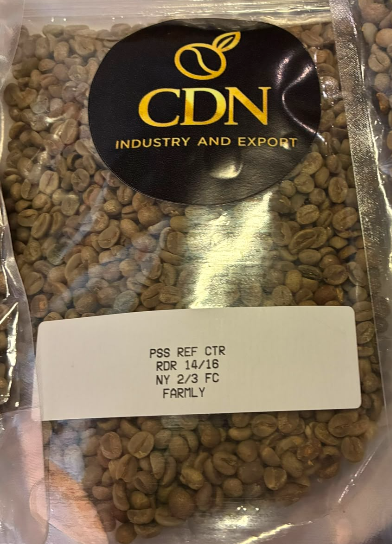
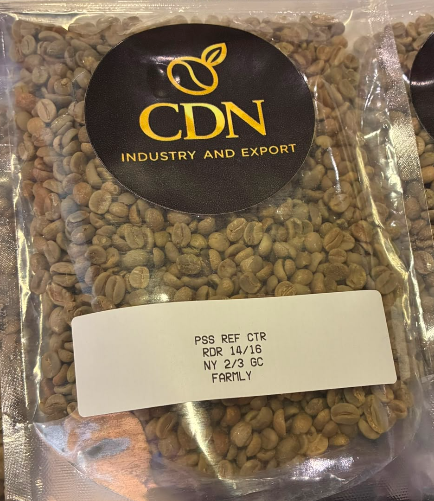
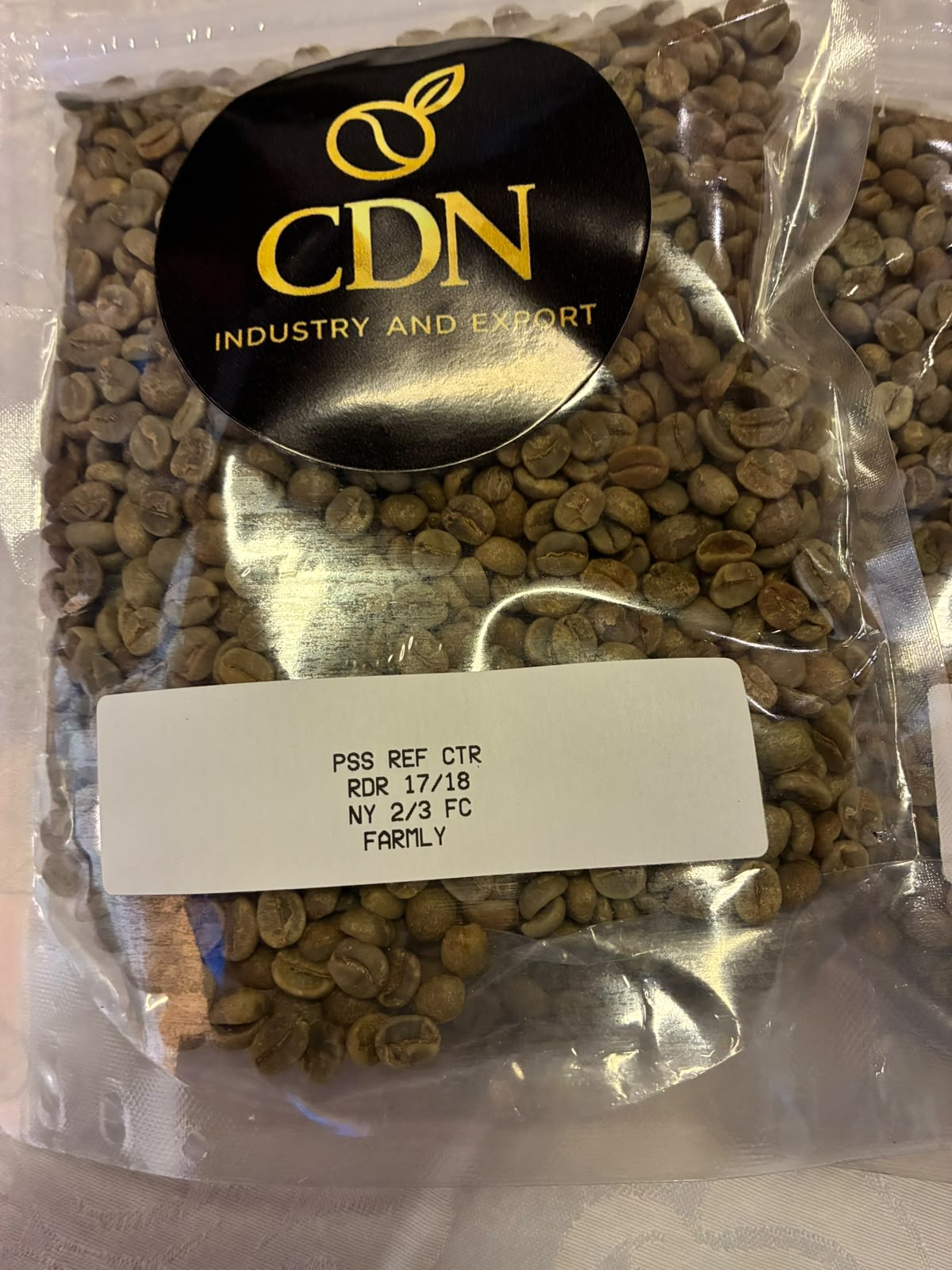
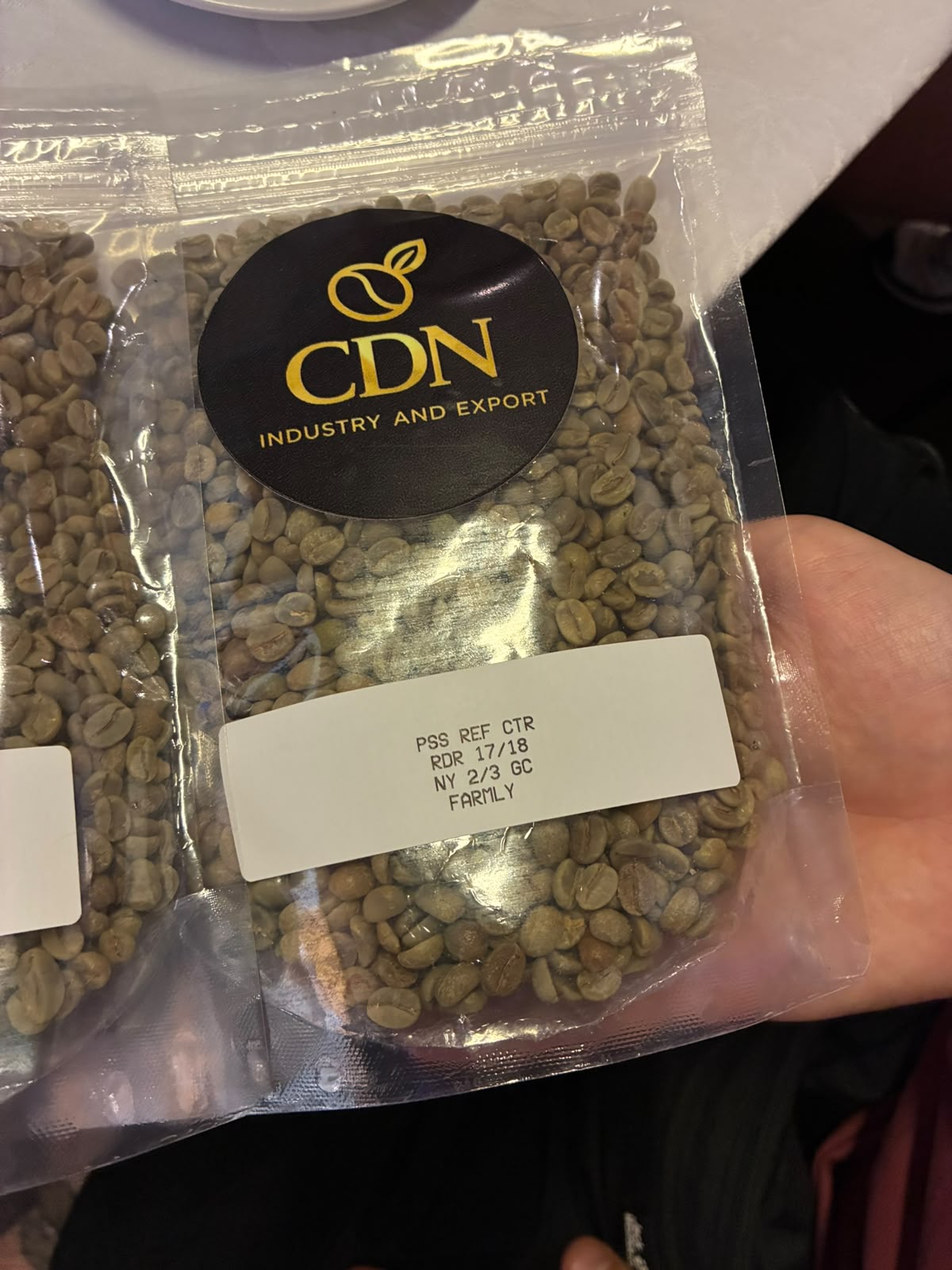
CDN Industry and Export
Four pre-shipment samples covering the full grid rather than a single point: two screens against two cup grades, all marked FARMLY. FC and GC are the two grades on your demand lines, so the comparison is like for like.
14/16 · FC
no lot number · for Fine cup
14/16NY 2/3
6.74USD/kg−8 ¢/lb
Green coffee only, FOB: before logistics and export costs
Would you buy this?
14/16 · GC
no lot number · for Good cup
14/16NY 2/3
6.65USD/kg−12 ¢/lb
Green coffee only, FOB: before logistics and export costs
Would you buy this?
17/18 · FC
no lot number · for Fine cup
17/18NY 2/3
7.09USD/kg+8 ¢/lb
Green coffee only, FOB: before logistics and export costs
Would you buy this?
17/18 · GC
no lot number · for Good cup
17/18NY 2/3
7.03USD/kg+5 ¢/lb
Green coffee only, FOB: before logistics and export costs
Would you buy this?
Minasul
Seven reference samples handed over at the Minasul cupping lab in Varginha: classic Sul de Minas profiles they use as house benchmarks.
Canário-da-Terra · Classic
no lot number
screen not stated
7.47USD/kg+25 ¢/lb
Green coffee only, FOB: before logistics and export costs
Would you buy this?
Dama-da-Noite · Reserve
no lot number
screen not stated
7.69USD/kg+35 ¢/lb
Green coffee only, FOB: before logistics and export costs
Would you buy this?
Elegance Natureza
no lot number
screen not stated
7.58USD/kg+30 ¢/lb
Green coffee only, FOB: before logistics and export costs
Would you buy this?
Fafo de Mel
no lot number
screen not stated
8.57USD/kg+75 ¢/lb
Green coffee only, FOB: before logistics and export costs
Would you buy this?
It's Up 20 · Experience
no lot number
screen not stated
8.57USD/kg+75 ¢/lb
Green coffee only, FOB: before logistics and export costs
Would you buy this?
Blue Cherry
no lot number
screen not stated
7.91USD/kg+45 ¢/lb
Green coffee only, FOB: before logistics and export costs
Would you buy this?
AMAM Cherry
no lot number
screen not stated
Price not quoted yet
Would you buy this?
Minasul: commercial grades
The other half of the Minasul table, and the one that matters most for volume. These close the same grid CDN handed over: fine cup and good cup against 14/16 and 17/18. That means two suppliers are now quoting the identical spec matrix and the comparison can be made like for like, on the same four specs, rather than supplier by supplier. Peaberry sits outside the grid as a separate offer.
Fine cup 14/16
no lot number · for Fine cup
14/16
6.98USD/kg+3 ¢/lb
Green coffee only, FOB: before logistics and export costs
Would you buy this?
Good cup 14/16
no lot number · for Good cup
14/16
6.70USD/kg−10 ¢/lb
Green coffee only, FOB: before logistics and export costs
Would you buy this?
Fine cup 17/18
no lot number · for Fine cup
17/18
7.25USD/kg+15 ¢/lb
Green coffee only, FOB: before logistics and export costs
Would you buy this?
Good cup 17/18
no lot number · for Good cup
17/18
6.98USD/kg+3 ¢/lb
Green coffee only, FOB: before logistics and export costs
Would you buy this?
Peaberry
no lot number
screen not stated
6.79USD/kg−6 ¢/lb
Green coffee only, FOB: before logistics and export costs
Would you buy this?
Labareda do Caititu
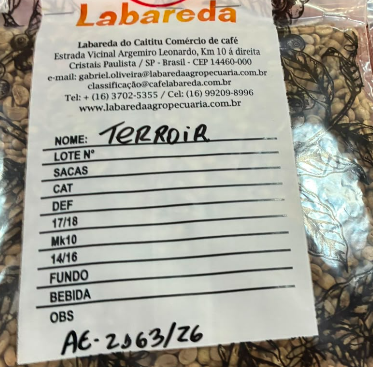
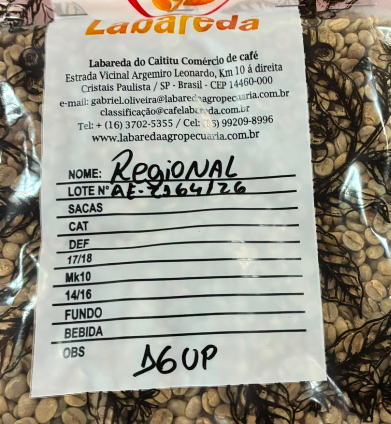
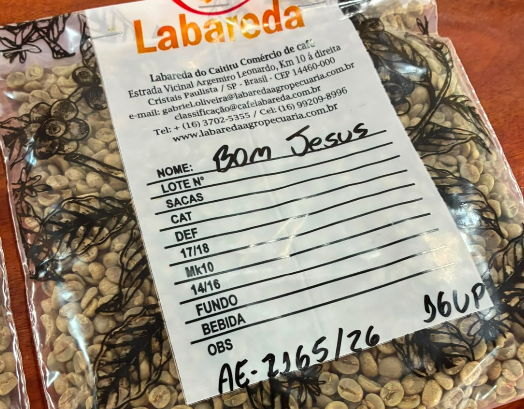
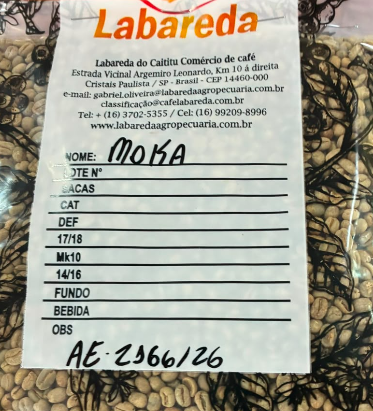
Four named lots from the 2026 crop, consecutive lot numbers. Worth knowing before cupping: every classification field on these labels (sacas, cat, def, 17/18, Mk10, 14/16, fundo, bebida) was left blank. Two bags carry a handwritten 16 up and that is the only spec on any of them.
Terroir
AE-2163/26
screen not stated
6.92USD/kgat NY
Green coffee only, FOB: before logistics and export costs
Would you buy this?
Regional
AE-2164/26
16 up
7.14USD/kg+10 ¢/lb
Green coffee only, FOB: before logistics and export costs
Would you buy this?
Bom Jesus
AE-2165/26
16 up
7.47USD/kg+25 ¢/lb
Green coffee only, FOB: before logistics and export costs
Would you buy this?
Moka
AE-2166/26
screen not stated
6.92USD/kgat NY
Green coffee only, FOB: before logistics and export costs
Would you buy this?
Fazenda Rodomunho, via Acauã
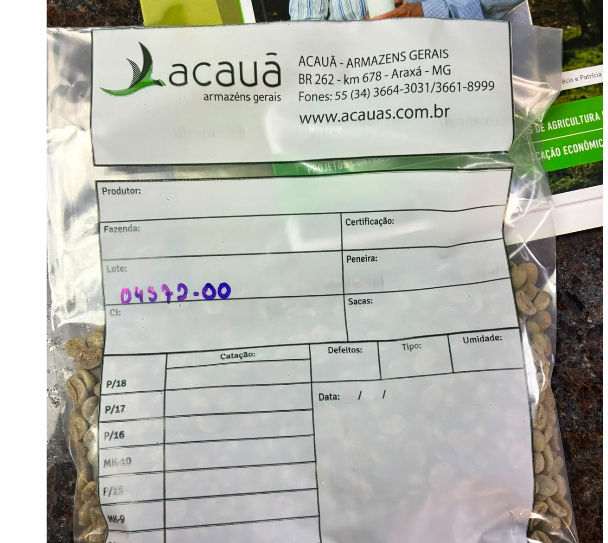
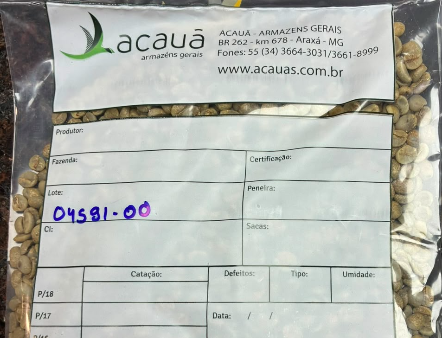
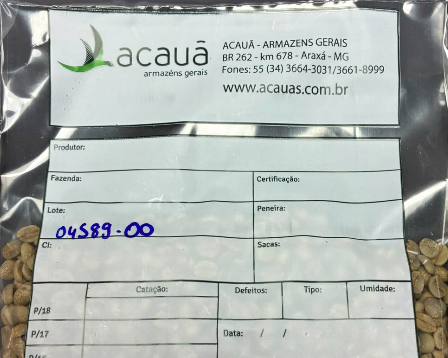
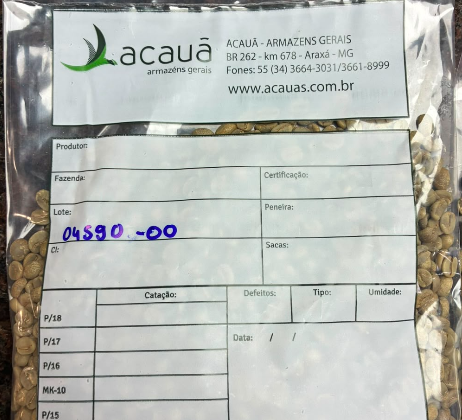
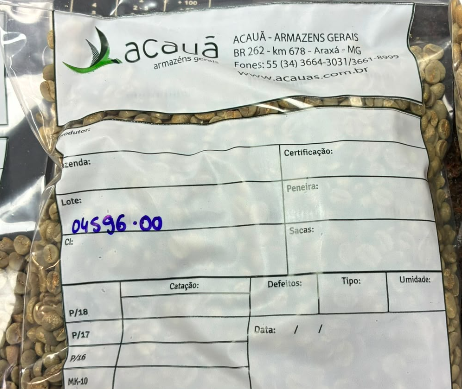
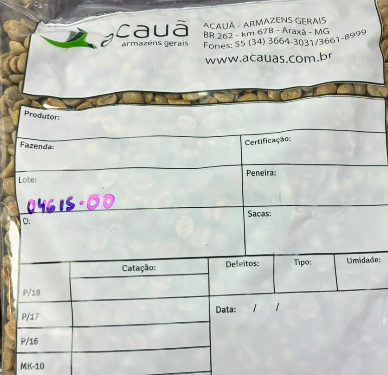
Six lots collected on the Araxá day, quoted at a flat 12 USD/kg. They come in Acauã bags because Acauã is where the coffee is prepared and stored, and the labels carry a lot number and nothing else: producer, farm, certification, screen, bags, catação, defects, type, moisture and every peneira line (P/18, P/17, P/16, MK-10, F/13, W-9) were left blank, and so was the date. Cupping these blind is a choice worth making deliberately rather than by default. Unlike the commercial grades above, this price is agreed outright and does not move with the market.
Lot 04572-00
04572-00
screen not stated
12.00USD/kgfixed price
Green coffee only, FOB: before logistics and export costs
Would you buy this?
Lot 04581-00
04581-00
screen not stated
12.00USD/kgfixed price
Green coffee only, FOB: before logistics and export costs
Would you buy this?
Lot 04589-00
04589-00
screen not stated
12.00USD/kgfixed price
Green coffee only, FOB: before logistics and export costs
Would you buy this?
Lot 04590-00
04590-00
screen not stated
12.00USD/kgfixed price
Green coffee only, FOB: before logistics and export costs
Would you buy this?
Lot 04596-00
04596-00
screen not stated
12.00USD/kgfixed price
Green coffee only, FOB: before logistics and export costs
Would you buy this?
Lot 04615-00
04615-00
screen not stated
12.00USD/kgfixed price
Green coffee only, FOB: before logistics and export costs
Each price is the coffee itself at today's market: the NY (KC) reference plus the differential the supplier quoted, FOB. It does not yet include inland freight to the port, terminal and export handling, documentation, ocean freight, insurance, or anything on the arrival side. Those are being priced separately and will land as a second layer on top of these numbers, so treat everything here as a floor for comparing suppliers against each other, not as a landed cost.
Inland freight to port
Terminal and export handling
Export documentation and certificates
Ocean freight
Insurance
Arrival costs at destination
The market moves; these figures are a snapshot at the reference above, not a firm offer. A differential is fixed at the moment of contracting, and the KC leg can move between that moment and shipment.
05
Your current book
Your contracted book, re-priced at today's market. The differential on each line is held exactly as contracted, so the gap you see is market movement and nothing else.
Containers booked
11thru November
Tonnes booked
211–220t
Market when booked
246–265¢/lb
Market today
313.80¢/lb · +23%
Coffee
Route & terms
Differential
When booked
Today
Var.
Arabica scr 14/16, NY 2/3, fine cup
Netherlands · EXW
100% cash before loading
delivery 10 days
+20 ¢/lb
+0.44 USD/kg
5.86–6.28
USD/kg
7.36
USD/kg
+21%
Arabica scr 14/16, NY 2/3, fine cup
Russia · Delivered St. Petersburg seaport
100% cash at seaport
delivery 3–4 days
+40 ¢/lb
+0.88 USD/kg
6.31–6.72
USD/kg
7.80
USD/kg
+20%
Arabica scr 17/18, NY 2/3, fine cup
Netherlands · EXW
100% cash before loading
delivery 10 days
+22 ¢/lb
+0.49 USD/kg
5.91–6.33
USD/kg
7.40
USD/kg
+21%
Arabica scr 17/18, NY 2/3, fine cup
Russia · Delivered St. Petersburg seaport
100% cash at seaport
delivery 3–4 days
+49 ¢/lb
+1.08 USD/kg
6.50–6.92
USD/kg
8.00
USD/kg
+19%
The book splits 8 containers through the Netherlands against 3 contracted locally, each 19.2–20 t. The Russian route costs roughly 20 ¢/lb more than the Dutch one on the same coffee, about 0.44 USD/kg, and buys them delivery in 3–4 days instead of 10. That premium is the number a Brazilian origin contract has to justify.
Background
Arabica market briefing
Every price here is market plus differential. The differential is what gets negotiated; the market is what moves underneath it, and in 2026 it has moved 188 cents, across a range of 244 to 432. The full briefing covers the 2026 price path, what is driving the volatility, the crop forecasts and the levels that matter from here.